The Great Divergence: Gemini 3.0 vs. GPT-5.1 – A Developer’s Perspective
November 2025 changed the landscape again. Google is democratizing creation with "Nano Banana" and agentic flows, while OpenAI aims to streamline engineering with adaptive intelligence. Here is a breakdown of the latest updates and what they mean for the future of software development.

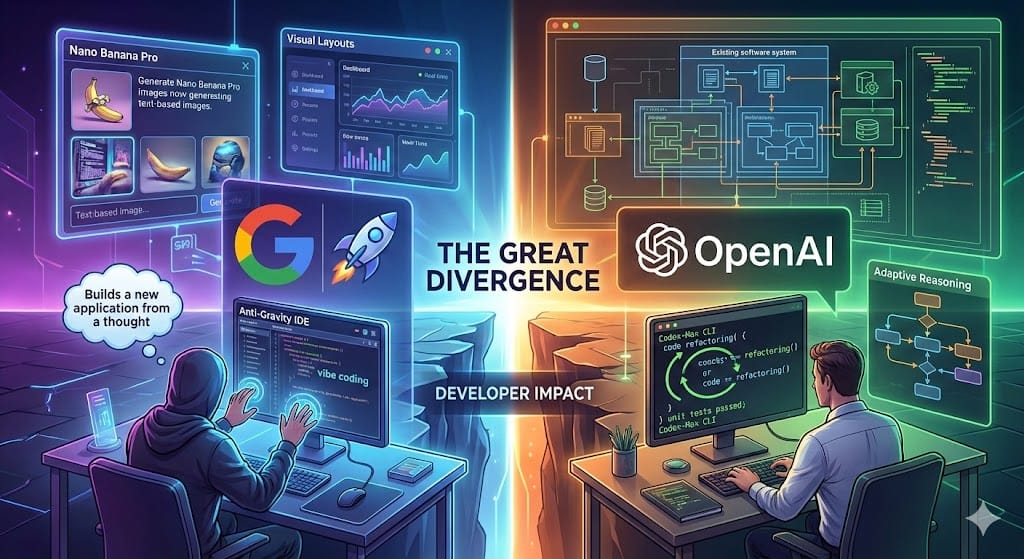
The AI wars have shifted gears. We are no longer just comparing context window sizes or benchmark scores on the MMLU. With the release of Google’s Gemini 3.0 Pro and OpenAI’s GPT-5.1, we are seeing a philosophical divergence in how these tools interact with code and creation.
I’ve spent the last few days analyzing both updates and the impact on my work. Here is the signal amidst the noise.
Google Gemini 3.0: The "Vibe Coding" Era
Google has aggressively rolled out its new stack, and for the first time in a while, they are leading the pack in pure capability. Gemini 3.0 Pro is now available to everyone, and according to recent benchmarks (and the "Humanity's Last Exam"), it is currently the leading LLM system on the market.
The Highlights
- Anti-Gravity IDE: A new development environment designed specifically for AI agents. It features an "Autonomy Slider" that lets you dictate how much control the AI has—from a simple chat assistant to a fully autonomous agent that plans, codes, and validates.
- Nano Banana Pro (Imagen 3 Upgrade): Also available to everyone, this model solves one of the biggest pain points in AI art: Text rendering. It can flawlessly integrate complex text into images, making it a first-class tool for creating marketing assets, mockups, and presentations without a designer.
- Visual Layouts (Visual Labs): The model moves beyond text responses. You can ask for an explanation, and Gemini can render interactive dashboards, diagrams, or entire UIs on the fly to visualize the data.
- Workspace Flows: A massive update for productivity. You can now build "Agents" directly within Gmail or Google Drive. For example, you can create a flow that automatically labels, categorizes, and drafts replies for specific types of emails.
The Verdict
Google is targeting Greenfield Development and Creative Autonomy. This is the tool for the "Zero to One" phase. If you are a solopreneur or an indie hacker, this is a game-changer. You can "vibe code"—describe an idea, and have a working MVP and the marketing assets ready in minutes.
The Risk: For enterprise environments, "Vibe coding" often results in "Black Box" code. It works, but if you don't understand the underlying architecture, maintaining it becomes a nightmare.
OpenAI GPT-5.1: The "Adaptive" Engineering Partner
OpenAI took a different route. With GPT-5.1, they aren't trying to hide the complexity; they are trying to manage it through "Adaptive Reasoning."
The Highlights
- Adaptive Reasoning: The new model replaces the confusing router system of the GPT-5.0 system. GPT-5.1 dynamically decides when a query is simpler (answering instantly) or complex (triggering a "Thinking" process).
- Codex-Max & CLI Workflow: This remains a main new feature for serious devs. The model is integrated into the CLI/terminal to run tests, fix code, and iterate in a loop. It’s built for "Brownfield" development—fixing and extending existing code.
- Group Chats: You can treat the AI as a team member in a group chat (up to 20 people), ideal for logging decisions or generating user stories from discussions. Unfortunately not yet available in Europe and Germany.
The Verdict
OpenAI is targeting Robustness and Refinement. This is the tool for the "One to N" phase. It excels at refactoring, writing unit tests, and navigating complex, existing codebases.
However, the "Adaptive" nature cuts both ways. For quick questions, it's efficient. But for complex debugging, the lack of transparency on how the model is reasoning (unless you force a specific mode) can be frustrating for power users who want predictable behavior.
The Impact: What This Means for Us
We are seeing a split in the developer tooling ecosystem:
- The Maker Path (Google): Lowering the barrier to entry. Great for prototyping, internal tools, and digital nomads who need to move fast. With Nano Banana and Workspace Flows, Google is building an operating system for Solopreneurs.
- The Architect Path (OpenAI): Increasing the ceiling of complexity. Great for maintaining large systems and improving code quality. The focus is on acting as a reliable Senior Engineer partner, even if the model selection process has become more opaque.
Conclusion
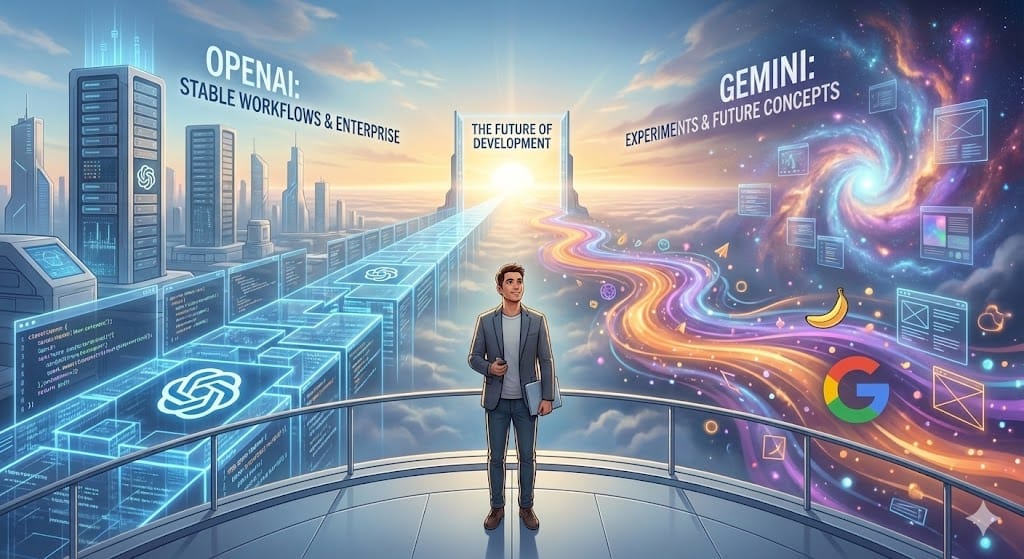
I will actively use Gemini 3.0 and Nanobana Pro to create my blogs and side projects and get a better feel for them. Gemini Anti-Gravity also represents a new advantage over Cursor for me, as I can achieve direct integration into the Google universe and my current setup as it is a VS Code derivate.
But when I open my IDE on Monday morning to refactor a complex Java backend service, I’ll likely be relying on GPT-5.1 and my VS Code setup.
The tools are getting better, but the responsibility for the architecture still lies with us.
Feedback
Would you like to learn more about how ChatGPT compares to Gemini, where their strengths lie, which company does what better, and where I think their strengths and future viability lie? Then let me know and I'll create a separate comparison.